FOR IMMEDIATE RELEASE
May 12, 2026
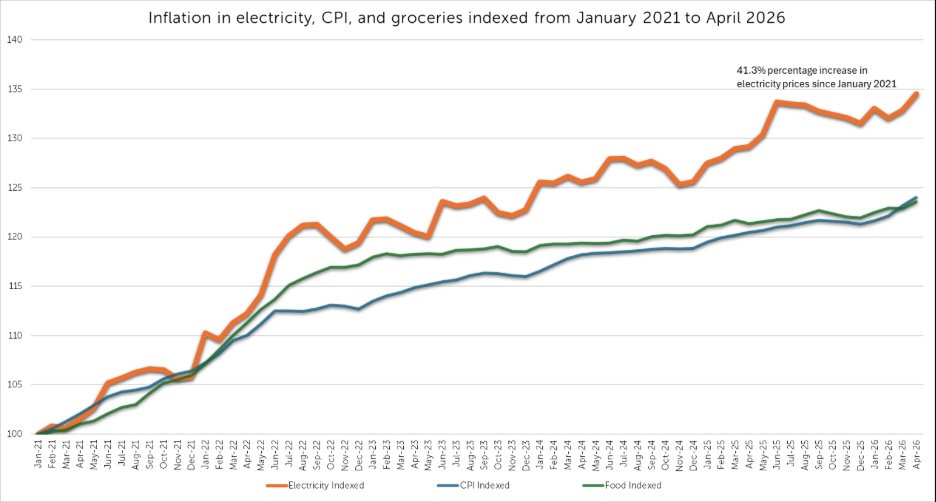
Electricity Prices Outpace the CPI by 61%
FERC Should Reject Utility Complaint to Prohibit Transmission Competition in MISO and SPP that Would Increase Electricity Prices in 20 States.
Washington, DC, May 12, 2026 — The latest Consumer Price Index (CPI) report highlights the burden of rising electricity prices on American consumers. Electricity prices increased by 6.1% on an annualized basis, compared to 3.8% for the overall CPI, continuing a trend of exceptionally high electricity bills1. This data comes at a critical moment, as FERC must decide whether to side with utility interests by granting a five-year exemption from requiring competition in building new transmission lines costing billions of dollars, or protecting consumers from high prices.
In April, twelve incumbent utilities petitioned FERC to prohibit transmission competition in SPP/MISO for five years which would increase electricity rates in 20 states. FERC should reject the complaint and enforce Order 1000, a common-sense federal policy that lowers transmission costs by requiring utilities to compete with one another to build new transmission lines.
Paul Cicio, Chair of the Electricity Transmission Competition Coalition shared the following statement, “The complaint illustrates that the utilities are completely insensitive to the affordability crisis. All they care about is increasing their profits. A monopoly utility has zero incentives to reduce costs without competition. In fact, fifteen recent projects that were not competitive saw an average cost overrun of 84 percent, costing consumers $4.8 billion.2” In a recent study of nineteen competitive transmission projects, competition reduced the costs of the projects on average by 38 percent, avoiding $4.9 billion in costs.3”
About the Electricity Transmission Competition Coalition
The Electricity Transmission Competition Coalition (ETCC) is a broad-based, nation-wide coalition committed to increasing competition in America’s electricity transmission infrastructure. We advocate for common-sense policies and solutions that result in competitively priced transmission projects, which reduce energy costs for all ratepayers – from large manufacturers to residential consumers. The ETCC represents a diverse group of 95 companies and organizations from all 50 states, including manufacturing groups, retail electric consumers, state consumer advocates, think tanks, and non-incumbent transmission developers.
For more information, visit: www.electricitytransmissioncompetitioncoalition.org.
Press Contact:
Ginger Felberg
Gfelberg@signaldc.com